Emmanuel Cardinal Nsubuga: From Namungongo to CUEA
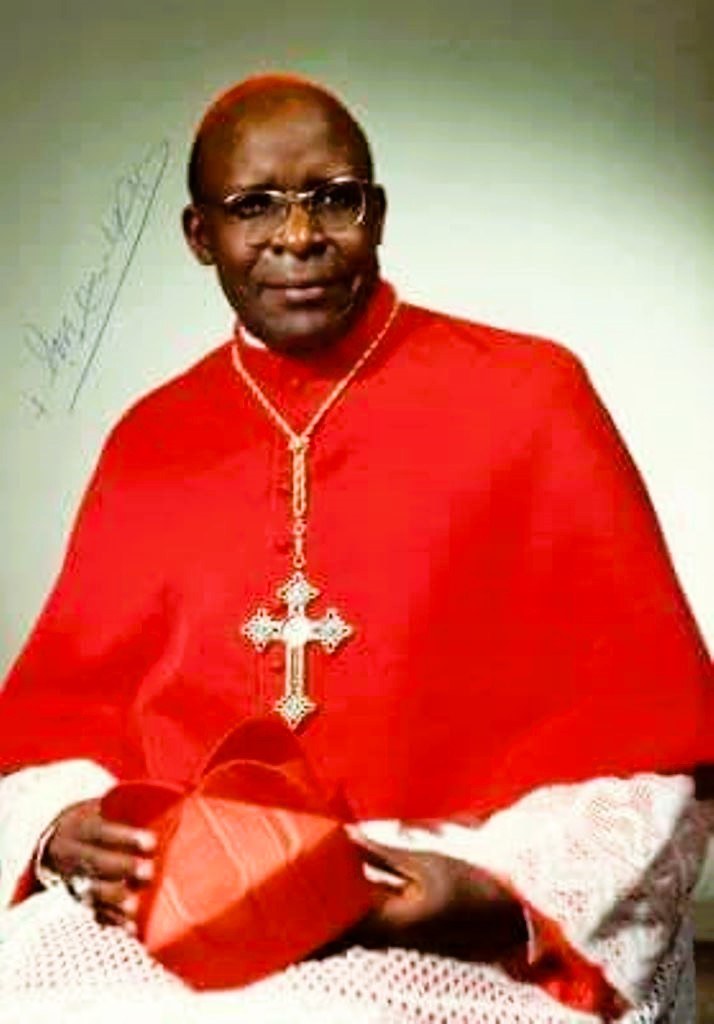
Long before Cardinal Nsubuga joined hands with other AMECEA Bishops to initiate CUEA, he helped greatly and personally in establishing the Namugongo national Prayer shrine in Uganda. Here at CUEA, we named a building in his name as one of the founding fathers of CUEA. We share a brief background about him.
In 1967, Kampala’s newly consecrated Archbishop traded the comfort of Rubaga Hill for a canvas tent in the bush. Wielding a machete alongside schoolchildren, nuns, and lay villagers, Emmanuel Nsubuga personally cleared trees, demolished an aging mud-walled church, and hauled away debris at a site once feared across the Buganda Kingdom as a royal execution ground, according to church archives and interviews with Namugongo clergy.
Two years later, that cleared ground at Namugongo hosted Pope Paul VI—marking the first papal visit to sub-Saharan Africa—and anchored one of the continent’s largest annual Christian pilgrimages.
While Nsubuga, who later became Uganda’s first cardinal, is widely remembered for confronting political tyranny during the turbulent 1970s and 1980s, historians Anatoli Lwassampijja and Pamela Khanakwa of Makerere University say his physical labor between 1966 and 1969 permanently embedded Catholicism into Uganda’s public landscape.
From Execution Ground to Sacred Ground
Long before it became Eastern Africa’s premier pilgrimage destination, Namugongo was a place of dread where individuals condemned by the Kabaka, or king, of Buganda met their deaths. Between January 1885 and January 1887, Kabaka Mwanga II ordered the execution of more than 45 Christian converts—including 22 young Catholic palace pages, among them Charles Lwanga, who was burned alive at Namugongo in 1886.
Historian D.A. Low noted in a 1957 study that Mwanga viewed the Christian converts as political insurgents conspiring with European colonial forces to undermine his authority. Ugandan historian Samwiri Lwanga-Lunyiigo later wrote that while the king harbored a certain fondness for the young converts, he saw their radical loyalty to a foreign faith as an existential threat to the state.
For decades after the executions, the site remained largely unmarked beyond a small structure erected by Joshua Serufasa Zaake, whose father had fought in Buganda's 19th-century religious wars, said the Rev. Joseph Mukasa Muwonge, a priest at Namugongo. Following the June 1920 beatification of the martyrs in Rome, a Dutch priest, the Rev. Stephen Walters, led a pilgrimage to the site and spearheaded the purchase of eight acres of land, resulting in a modest brick chapel dedicated to St. Charles Lwanga in 1935.
When Nsubuga was consecrated Archbishop of Kampala on Oct. 10, 1966—succeeding Uganda’s first indigenous bishop, Joseph Kiwanuka, and Archbishop Louis Joseph Cabana, according to church biographies—he set out to transform the humble memorial into a monumental sanctuary.
A Raffia Bag and a Papal Blessing
Born in 1914 in Ssingo County and ordained in 1946, Nsubuga understood that building a national shrine required grassroots mobilization rooted in Ganda communal traditions. As the late historian John Mary Waliggo observed, early Catholic evangelization in Buganda succeeded because local leaders and communities built chapels together, weaving the faith into the local cultural fabric.
Rather than relying solely on institutional funding, Nsubuga launched a nationwide fundraising campaign on March 26, 1967, during Mass at Rubaga Cathedral. Carrying an ekikapu—a woven raffia bag gifted to him during a pastoral visit to Naggalama Parish—he collected more than 8,000 Ugandan shillings on the first day alone.
The campaign soon went international. Accompanied by senior clergy, Nsubuga carried the raffia bag to Rome and the United States. At the Vatican, Pope Paul VI blessed the bag and donated 140,000 UG shillings toward the project, accepting Nsubuga’s invitation to travel to Uganda to lay the foundation stone and consecrate the new altar.
Architecture Rooted in Local Identity
Designed by German architect Justus Dahinden and built by Roko Construction Co., the resulting basilica deliberately merged Catholic liturgy with indigenous symbolism, according to parish records:
• Indigenous Form: The shrine was modeled after a traditional circular African hut rather than a European cathedral.
• Symbolic Structure: Twenty-two towering copper pillars support the roof, representing each of the 22 Catholic martyrs.
• Sacred Geography: The main altar was positioned directly over the spot where St. Charles Lwanga was executed.
On Aug. 2, 1969, Pope Paul VI consecrated that altar. Scholar Alison Bennett has noted that tangible religious objects and sacred spaces—much like the Miraculous Medals that earlier shaped Catholic identity in Buddu province—anchor faith by connecting worshipers physically to their spiritual history. Namugongo, later designated a minor basilica by the Vatican and visited by Pope John Paul II in 1993 and Pope Francis in 2015, became that permanent anchor.
The Voice for the Voiceless